

Richmond sits at the centre of Metro Vancouver’s industrial and airport economy, and its commercial assessments reflect that. If you own commercial or industrial property in Richmond and believe the value is too high, you can challenge it through the same BC appeal process used everywhere in the province. What is specific to Richmond is the local tax rate, and the market forces pushing values up.
How do commercial property assessments work in Richmond?
BC Assessment, not the City of Richmond, sets the assessed value of every Richmond property. Each year it estimates market value as of July 1 of the prior year, and the City then applies its tax rate to that value. An appeal challenges the value BC Assessment assigned, not the rate the City charges. The two are separate steps run by separate organizations.
Across BC, BC Assessment values about 2,233,648 properties, and roughly 99 percent of owners accept their assessment without appealing. That figure is a useful reality check: appeals are the exception, and for most Richmond owners the assessment is close enough to leave alone. But commercial property is valued using the income approach, on assumed rents, vacancy and a capitalization rate, and in a market moving as fast as Richmond’s, those assumptions can lag or overshoot what a specific building actually earns. Our guide on how BC Assessment values commercial property explains where the gaps tend to open up.
Classification matters as much as value in Richmond, where industrial, agricultural and airport lands sit close together. The Province defines the property classes that set the rate: a distribution or cold-storage building is usually Class 5 (Light Industry), while office and retail space is Class 6 (Business and Other). A property put in the wrong class, or split across classes in the wrong proportion, can be taxed at the wrong rate even if the value is right, which is a ground of appeal in its own right and one that comes up often on Richmond’s mixed industrial and airport-area sites.
What is driving Richmond commercial values?
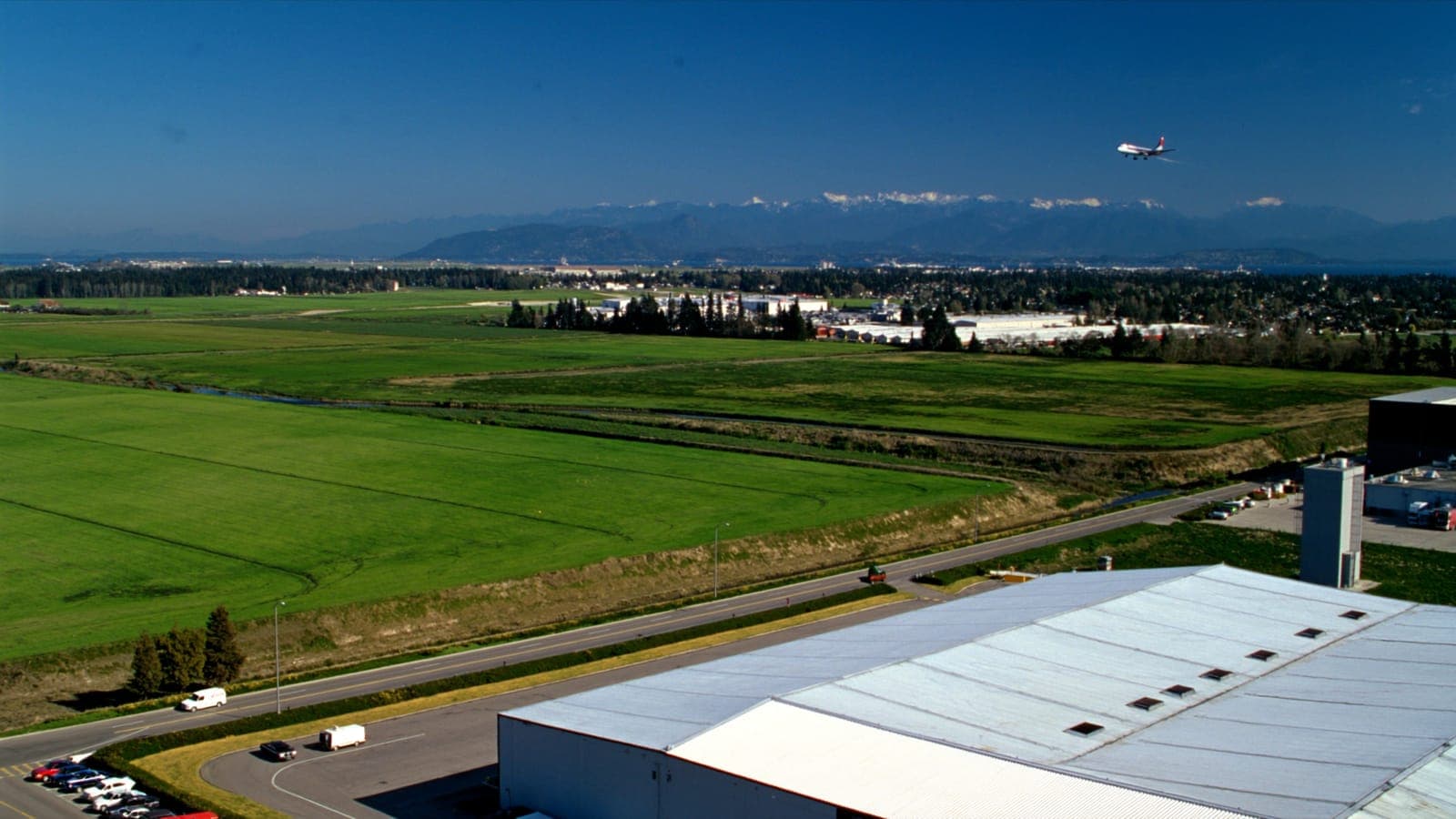
Proximity to Vancouver International Airport is Richmond’s defining commercial pressure. Richmond is one of Metro Vancouver’s largest industrial submarkets, and land next to YVR is in heavy demand for logistics, distribution and air cargo. Airport-adjacent supply is limited, and tight supply pushes land and building values up, which flows straight into assessments.
Cold storage and modern distribution space add to that. Purpose-built cold-storage facilities near the airport and the U.S. border command premium rents, and large new campuses such as the Richmond Industrial Centre are adding millions of square feet of Class A space. New, high-value construction lifts the assessment base for the whole submarket, and an older warehouse can find itself assessed against the yardstick of newer, more expensive buildings nearby. That is a common source of over-assessment worth testing: a functional but dated Richmond industrial building valued as if it were current-generation space.
Richmond also carries a large agricultural land base and airport lands with their own use restrictions, so classification and permitted use matter more here than in some municipalities. A property partly on restricted land, or valued on redevelopment potential its zoning does not actually allow, can be assessed above what its real, permitted use supports. Those are precisely the questions a Richmond commercial appeal can raise.
The flip side is worth stating plainly. A tight, high-demand market like Richmond’s means many commercial assessments are simply tracking real increases in land and rents, and those are not over-assessments. The value of knowing what drives Richmond values is not to assume every notice is inflated, but to recognize the specific situations where a gap opens, an older building measured against newer stock, a restricted-use property valued on unrealizable potential, or an income figure the building cannot actually reach, and to test those before deciding to appeal.
What are Richmond’s commercial tax rates and what is a reduction worth?
Richmond sets its tax rates each year by bylaw, expressed per $1,000 of assessed value. For 2025, the City of Richmond’s tax rate schedule set the total Business (Class 6) rate at 8.61504 and the total Light Industry (Class 5) rate at 8.49326 per $1,000, both including school and regional charges. The municipal portion alone was about 3.86 for each of those two classes.
Those rates turn a reduction into real money. As an illustration of the method, take a Class 6 business property and assume an appeal lowers its assessed value by $1,000,000. At the 2025 total rate of about 8.62 per $1,000, that reduction removes roughly $8,615 of tax in one year. The number is arithmetic applied to a hypothetical reduction, not a prediction of any outcome, but it shows the leverage: on a large Richmond distribution or cold-storage building, even a modest percentage correction can be worth a meaningful annual saving. Because a corrected value carries forward, the benefit repeats each year the lower base holds rather than arriving once.
The size of the rate is also why commercial appeals are judged on dollars rather than headline percentages. A large Richmond industrial property with a small over-assessment can be worth more to appeal than a small property with a large one. Our guide on whether you should appeal walks through weighing that, including the situations where the honest answer is to leave the assessment alone. Owners weighing industrial holdings across the region can compare the local numbers in our guides to commercial appeals in Surrey, Vancouver and Burnaby.
How do you appeal a Richmond commercial assessment?
The appeal process runs the same way across British Columbia, so a Richmond file moves through the same two levels as any other. You appeal a Richmond commercial assessment by filing a Notice of Complaint with BC Assessment by January 31, which brings your file to the Property Assessment Review Panel. Filing there is free, and most matters are settled at that level. BC Assessment sets out what a complaint must include and the steps that follow in its complaint guide, and it states plainly that a percentage change alone is not a valid reason to request a review.
If the panel does not resolve your concern, the second level is the Property Assessment Appeal Board, with an April 30 deadline and a fee of $300 per folio for a commercial or industrial property. Our guide comparing the review panel and the appeal board explains when each level applies, and our guide to appeal fees in BC sets out the cost at each stage.
It is often worth contacting BC Assessment before filing, since many issues are corrected through a conversation rather than a formal complaint — and for commercial owners, the fall pre-roll review can settle a value before notices even mail. If you do go ahead, our guide on how to appeal your BC Assessment covers each step, and our guide to BC Assessment appeal deadlines gives the exact dates for the current roll. For a Richmond commercial property, the strongest cases rest on actual rents and vacancy, comparable assessments, and any classification or permitted-use error, not on the fact that the value rose.
What evidence carries a Richmond industrial appeal?
Most Richmond commercial appeals are industrial, and the evidence that moves them is the evidence of what the building earns and how it compares. For a warehouse or distribution building assessed against newer, higher-value stock, the case rests on the rent roll and lease terms, the real occupancy, and comparable assessments for buildings of similar age and quality nearby. Where a functional but dated building has been valued as if it were current-generation space, that difference between the assumed and the actual income is the argument.
Permitted use is the second Richmond-specific line of evidence. The roll reflects the property’s permitted use as of a fixed date each year, so a site on agricultural land, or one whose zoning does not support the redevelopment the assessment seems to assume, may be worth less than the figure on the notice. Documenting the actual zoning, any airport-land restriction, and what the site can lawfully be used for today is often what separates a Richmond over-assessment from a value that is simply keeping pace with a tight market.
Most of the effort in a Richmond appeal is in building that record: assembling the rent roll and operating figures, identifying comparable assessments for similar airport-area or industrial properties, and lining them up against BC Assessment’s assumptions. Because the review panel and the appeal board both work largely in writing, a clear and specific submission carries the argument, and there is rarely any hearing to attend. If you would prefer the whole thing handled, reviewing the portfolio, preparing the evidence, filing and tracking the result, that is what we do, and you pay only when a reduction is won.
Common questions
- When is the deadline to appeal a Richmond commercial assessment?
- January 31, the same deadline used across BC. You file a Notice of Complaint with BC Assessment to reach the Property Assessment Review Panel, and there is no fee at that level. When January 31 lands on a weekend, the deadline rolls to the next business day.
- What is a Richmond commercial assessment reduction worth?
- It depends on the class rate. For 2025, Richmond's Business (Class 6) total rate was about 8.62 per $1,000 of assessed value, so a $1,000,000 assessment reduction on a Class 6 property removes roughly $8,615 of tax per year, repeating each year the lower value holds.
- Why are Richmond industrial assessments high?
- Richmond is one of Metro Vancouver's largest industrial submarkets, and land near Vancouver International Airport is scarce and in strong demand for logistics, distribution and cold storage. Tight supply pushes land and building values up, and higher values feed higher assessments.
- Can appealing a Richmond commercial property raise the value?
- Yes. A review panel reviews the entire assessment, so a property that is under-assessed relative to its income or comparable properties can have its value confirmed or increased. Checking the evidence before filing, rather than appealing on the size of the increase, protects against that risk.
- Do I have to attend a hearing to appeal in Richmond?
- Usually not. Review panel sessions are held by phone or in writing, and the appeal board decides most matters on written submissions. A well-documented written case does most of the work at both levels for Richmond properties.
- Where do I find Richmond's current commercial tax rates?
- The City of Richmond sets its rates each year by bylaw and posts a tax rate schedule by property class, per $1,000 of assessed value, with school and regional charges included in the total. Rates change every year, so use the City's schedule for the year on your notice rather than a figure from a prior year.